
It’s a race to the bottom. The operators who win don’t run that race. They make their facility the obvious choice in their local market before the customer ever opens the comparison tab. That’s a marketing problem. It’s also a solvable one.
This page is for operators who want to stop paying SpareFoot for the same leads forever and start owning their local search results. We’ve done it. We’re doing it right now for Click Storage. Here’s how it actually works.
The landscape: why self storage is the most under-content-marketed local business in America
| Marketing Channel | What Most Operators Get | Main Problem | Long-Term Value |
|---|---|---|---|
| Google Business Profile | Local visibility | Easy for competitors to replicate | High |
| Paid Search Ads | Immediate leads | Rising CPCs and price wars | Low |
| Listing Aggregators (SpareFoot, etc.) | Additional move-ins | Lead fees and no customer ownership | Low |
| Organic SEO & Local Content | Compounding local traffic | Requires long-term strategy | High |
| Hyper-Local Content Clusters | Rankings for local intent searches | Needs consistent publishing | Very High |
The difference is simple: most channels rent attention, while organic search builds an asset your facility owns.
Self storage is one of the most competitive local search markets in the country and one of the worst-served by content marketing. That sounds contradictory. It isn’t.
Here’s why. Most operators rely on three lead sources: their Google Business Profile, paid search, and listing aggregators (SpareFoot, Sparefoot’s parent Neighbor, RVshare-style platforms for boat/RV storage). All three commoditize the operator. The Google Business Profile is a checkbox. Paid search is a price war. The aggregators charge you a finder’s fee for a customer who was never really yours to begin with.
What’s missing from the typical storage marketing stack is the one channel that actually compounds: organic search built on local SEO and strategic content marketing. The reason it’s missing isn’t because it doesn’t work. It’s because it’s slow, it’s hard to outsource to a generic agency, and most storage software vendors who offer marketing services treat content as an afterthought to their platform.
Most “storage marketing agencies” run the same playbook for every client: optimize the GBP, run paid search, plug in a basic website. That’s not a strategy. That’s a checklist. M6 starts somewhere different.
The M6 approach: strategy before content, content before paid
We work in three steps. The order matters.
Step 1. Audit the business, not just the website.
Before we touch a single page, we ask the questions most marketers don’t. Who’s actually choosing your facility today and why? What’s your real conversion rate from inquiry to move-in? How does your unit mix compare to demand in your market? What’s your average tenant tenure? What’s your move-in cost per channel, today, calculated honestly?
We’ve seen operators spending $80 per move-in on paid search and not realize it because nobody calculated the cost. We’ve seen facilities running 92% occupancy on small units and 64% on large units and treating it as one number. The audit makes the invisible visible.
Step 2. Define the real differentiator.
Most operators say their differentiator is “clean, secure, locally owned.” That’s table stakes. The real differentiator is usually one or two of: tenant relationships (people stay because they trust you), specific amenities (climate-controlled storage, oversized RV bays, 24-hour access for contractors), local positioning (you’re the obvious choice for a specific job, like “the storage facility next to the I-44 exit”), or operator presence (the customer knows who’s running the place).
If we can’t articulate the differentiator in one sentence, we can’t write content that ranks for the right reasons.
Step 3. Build a content architecture, not a blog.
This is where most agencies stop short. They write a few blog posts on storage tips, hope something ranks, and quit when nothing does in 90 days. We build pillar pages around the high-intent terms (“self storage [city]”, “climate controlled storage [city]”, “RV storage [city]”), surround them with cluster pages on adjacent intent terms, link the architecture together, and publish on a cadence that signals to Google that we’re a topical authority.
What working with M6 actually looks like
| Timeline | What Happens | Expected Outcome |
|---|---|---|
| First 30 Days | Audit, strategy, first pillar + cluster content | Foundation established |
| Days 30–90 | Technical SEO, publishing cadence, internal linking | Topical authority begins building |
| Days 90–180 | Ranking movement and organic traffic growth | Lower dependency on paid ads |
| After Month 6 | Expansion and optimization | Long-term compounding traffic |
First 30 days: we run the full audit, deliver the strategy document, and ship the first pillar page plus three cluster pages. You see live content within the first month.
Days 30-90: we publish on a regular cadence (typically four to six pieces per month, custom to your market), do the technical SEO cleanup (page speed, schema, internal linking), and clean up your local citations. By the end of month three, you have a content library and a real internal linking structure.
Days 90-180: we start seeing position movement on the primary local terms. Most facilities we’ve worked with see a measurable lift in non-branded organic traffic by month four. Move-in attribution gets cleaner. Paid search budget can usually come down 20-30% as organic picks up the slack.
After month six: maintenance, refresh, expansion into adjacent markets if you operate multiple facilities. We’re not a churn-and-burn agency. We’re built to work with operators for years, not months.
Case study: Click Storage
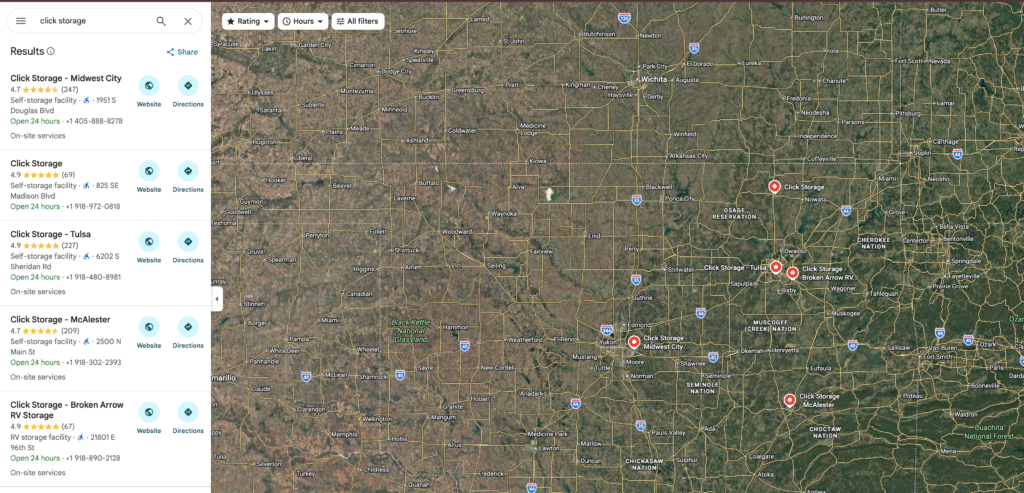
Click Storage is an active M6 client and the proof point for our storage approach. We’ve produced consistent blog content over multiple months targeting local storage searches in their market. The content strategy was deliberate: rank for hyper-local terms first (the kind that convert), then expand to broader storage queries that build topical authority.
The work isn’t flashy. It’s a piece a week, written in the operator’s voice, optimized for local intent. We track unit-level occupancy alongside ranking position so the marketing data ties back to the business outcome. That’s a level of integration most storage marketing vendors don’t even attempt.
If you operate a self storage facility and you want to stop competing on price, we should talk. We’ll spend thirty minutes on the phone, look at your market, and tell you whether we’re the right fit. No pitch deck. No retainer pressure. Just a conversation about your business.
 Work With M6 Marketing
 M6 Services
 Related Articles