That is the most competitive, most commoditized point in the entire journey. It is also the last point where content can meaningfully influence the decision. The operators who understand the full journey, and who build content that meets customers at every stage of it, acquire customers earlier, convert them at higher rates, and retain them longer than operators who only compete at the bottom of the funnel.
The four stages of the self storage customer journey
The self storage customer journey is not a straight line from search to rental. It is a progression through four distinct stages, each with different search behavior, different questions, and different content needs. Understanding the stages is what makes it possible to build a content and SEO strategy that captures demand at every point rather than only at the end.
Stage one: the trigger event
Nobody wakes up thinking about storage. Storage is a reaction to something else happening in a person’s life or business. A move. A divorce. A death in the family that leaves belongings to sort through. A baby arriving and a spare room disappearing. A home renovation that displaces furniture. A business growing out of its office space. A seasonal inventory problem. A contractor who needs somewhere to keep tools and materials between jobs.
The trigger event is the starting point of the journey, and it happens before any search occurs. The customer is not thinking about facilities or prices or access hours. They are thinking about the problem the trigger event created. The marketing question at this stage is not “how do I rank for storage keywords” but “what does a person in this situation search for before they search for storage?”
Stage two: awareness search
After the trigger event, the customer enters the awareness stage. They may not yet know that storage is the answer to their problem. They search for the problem itself. “What to do with furniture during a home renovation.” “How to downsize before a move.” “Where to keep business inventory without renting office space.” “Decluttering after a death in the family.” These are not storage searches. They are problem searches. The customer is looking for solutions and storage is one of several answers they may encounter.
Content that appears at this stage earns something valuable: the customer’s attention before any competitor has reached them. A storage operator whose blog ranks for “what to do with furniture during a home renovation” captures a qualified reader who is weeks away from a rental decision, not days. That reader signs up for the email list, reads more content, and arrives at the comparison stage already trusting the brand. The competitor who only runs Google Ads meets that same customer for the first time when they are comparing prices on three different facility websites.
Stage three: comparison search
Once the customer has identified storage as a solution, they enter the comparison stage. This is where most operators concentrate all of their marketing effort. The customer is now searching for “[city name] self storage,” “storage units near me,” “climate controlled storage [neighborhood],” and “[facility name] reviews.” They are evaluating options based on location, price, access, and reviews.
The comparison stage is important and well understood. Google Business Profile optimization, local pack visibility, review volume and quality, and pricing page clarity all determine performance at this stage. The problem is that most operators treat this as the only stage and build their entire marketing infrastructure around it. The result is that they compete on the most commoditized terms, at the highest cost, against the most competitors, with no relationship advantage going into the conversation.
Stage four: the decision
The decision stage is where the customer chooses a facility and completes a rental. It is influenced by everything that happened in stages one through three. A customer who arrived through awareness-stage content has more brand familiarity and more trust than a customer who found the facility through a paid ad thirty minutes ago. A customer who has read three pieces of content from a facility’s blog converts at a higher rate and with less price sensitivity than one who came in cold.
The decision stage is also where operations take over from marketing. The facility that wins in stages one through three and then delivers a poor move-in experience loses the long game. Reviews, referrals, and renewal decisions are all downstream of the decision stage. Conversion and retention are marketing problems as much as operational ones, and they begin with the quality of the content relationship established earlier in the journey.
What triggers a storage search and when
The trigger events that drive storage demand are not evenly distributed across the calendar. Understanding the seasonality of triggers is part of building a content strategy that reaches customers at the right moment.
Life events and their timing
Residential moves cluster in the late spring and summer. The storage demand that follows them peaks between May and August. College students moving out of dorms create a specific demand spike in May and a second one in August. Divorce proceedings, which generate significant storage demand, file more frequently in January and March than at other times of year. Estate cleanouts after a death in the family happen year-round but are emotionally driven, making empathetic, practical content more important than price-forward messaging at that stage.
Home renovations drive storage demand in spring and early fall. Baby arrivals create nursery-clearing storage demand that follows birth seasonality, with peaks nine months after major holidays. Each of these trigger types has a different lead time before the customer starts searching for storage, a different emotional register, and different content that will resonate at the awareness stage.
Business triggers
Business storage demand is less seasonal and more event-driven. A business that lands a large contract needs somewhere to hold inventory. A contractor wins a project and needs to store equipment. A retail operation closes and needs temporary storage for fixtures. An office relocates and needs somewhere to put furniture during the transition. These customers often search with more urgency and less price sensitivity than residential customers, and they are underserved by most storage operator content strategies, which focus almost entirely on the residential customer journey.
How search behavior changes across the journey
The queries customers use change significantly as they move through the self storage customer journey. Mapping content to query type is what makes the difference between a content strategy that ranks and one that simply publishes.
Top-funnel queries
Top-funnel queries are problem-oriented. The customer is not searching for storage. They are searching for help with the situation that will eventually lead them to storage. “How to pack up a house for renovation.” “What to keep and what to donate when downsizing.” “How to store a classic car for winter.” “Temporary storage options for home renovation.” These queries have informational intent. The content that ranks for them is practical, specific, and genuinely useful. It does not lead with a sales message.
The goal of top-funnel content is not direct conversion. It is relationship building. A reader who finds a useful guide to downsizing on a storage facility’s website builds a passive brand association that influences the comparison stage decision weeks later. They may not remember exactly where they read the article. They will recognize the brand name when they see it in the local pack.
Mid-funnel queries
Mid-funnel queries are solution-oriented. The customer knows they need storage and is beginning to understand their options. “How much does storage cost per month.” “What size storage unit do I need.” “Climate controlled vs. regular storage.” “Indoor vs. outdoor storage units.” “Self storage vs. portable storage.” These queries have commercial research intent. The customer is gathering information to make a decision, not yet comparing specific facilities.
Content that ranks for mid-funnel queries positions the facility as an authoritative resource in the category before the customer reaches the comparison stage. A comprehensive guide to storage unit sizes that ranks for “what size storage unit do I need” captures a customer who is in research mode and delivers them to the facility’s website with a positive first impression. Organic rankings on mid-funnel terms are often less competitive than local pack terms and produce higher-quality leads because the customer arrives more informed and more committed.
Bottom-funnel queries
Bottom-funnel queries are transactional. “Storage units in [city].” “Self storage near me.” “Climate controlled storage [neighborhood].” “[Facility name] reviews.” “[Facility name] prices.” The customer is ready to rent or very close to it. This is where local pack visibility, review quality, and pricing page clarity determine conversion. It is also the most competitive, highest-cost segment for paid advertising, and the segment where most storage operators spend all of their marketing budget.
Bottom-funnel optimization is necessary but not sufficient. A facility that only shows up at the bottom of the funnel is competing on a level playing field with every other facility in the area. A facility that also shows up at the top and middle of the funnel has a relationship advantage that competitors without a content strategy cannot match.
What content each stage actually needs
The content type that works at one stage of the self storage customer journey is largely wrong for every other stage. Publishing the wrong content for a stage is why many storage blogs produce traffic that doesn’t convert and conversion-focused pages that don’t produce traffic.
Top-funnel content
Long-form guides and listicles on trigger event topics. Moving guides. Downsizing checklists. Seasonal storage guides for specific categories: holiday decorations, sporting equipment, vehicles, wine, documents. Estate cleanout resources. Home renovation planning content that includes storage as part of the planning process. The writing voice at this stage should be practical and empathetic, not sales-oriented. The reader has a problem. Help them with it. The brand association follows naturally.
Mid-funnel content
Comparison and educational content. Unit size guides with visual references for what fits in each size. Climate control explained, what it is, when it matters, and when it doesn’t justify the cost premium. Pricing guides that explain how storage facilities charge, what to watch for in contracts, and how to estimate total cost of a rental. Packing and storage tips by category. This content converts readers from awareness to comparison readiness and sends them into the local pack search already knowing what they want and why.
Bottom-funnel content
Service pages optimized for local terms, facility pages for each location, and review-rich landing pages. This is the content that converts intent into action. It needs to be fast, specific, and clear on the three things the customer needs to know at this stage: where the facility is, what it costs, and what other customers have said about it. Every word that doesn’t serve those three goals is a word that slows the conversion.
Why most storage operators only market to the bottom of the funnel
The answer is attribution. Bottom-funnel conversions have clear attribution. A customer searches “storage units Tulsa,” clicks a Google Ad, lands on a facility page, and rents a unit. The ad gets the credit. Top-funnel content that influenced the same customer’s brand familiarity six weeks earlier gets no credit in the last-click model. Most storage operators optimize toward credited channels and underinvest in channels that don’t receive attribution credit even when those channels do meaningful work.
The second reason is effort. A bottom-funnel paid campaign is faster to launch and easier to measure than a top-funnel content strategy. The content strategy requires consistent publishing over months before it produces measurable results. The paid campaign produces leads this week. Most operators choose the faster option and wonder why the cost per lead keeps rising.
How M6 maps content to the journey for storage clients
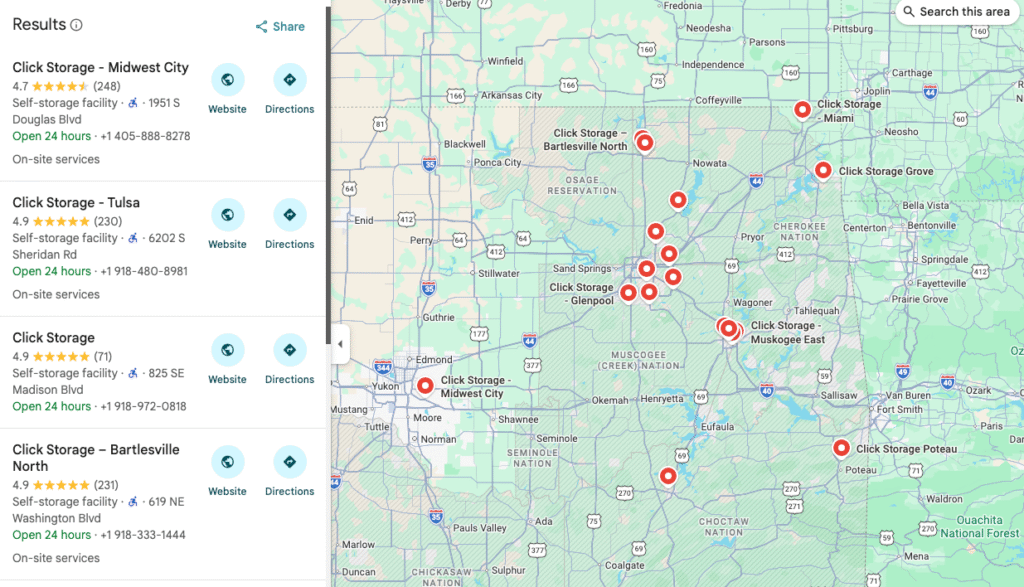
For ClickStorage, M6 builds content across all three funnel stages simultaneously. Top-funnel content captures demand before the customer knows they are in the market. Mid-funnel content builds authority and educates the comparison-stage reader. Bottom-funnel service pages and GBP optimization convert the customer who is ready to act. The reporting ties each stage’s content to move-in data, so the strategy isn’t optimized toward traffic metrics that don’t reflect business outcomes.
The result is a content library that grows in value over time instead of a paid campaign that stops working the moment the budget pauses. The facilities that run this model reach customers earlier, build more trust before the comparison conversation starts, and retain tenants longer because the relationship began with something more than a discount ad.
If you operate a storage facility and your marketing only reaches customers at the moment they are comparing prices, you are missing two-thirds of the journey. We should talk. Thirty minutes on the phone. We will map your current content against the journey and tell you where the gaps are.
 Work With M6 Marketing
 M6 Services
 Related Articles